Before the sociologists and the documentaries, the road wrote itself in the first person—memoirs, fieldwork notebooks, and the offhand speech of people who expected no audience.
Histories of freighthopping lean hard on observers: census clerks, railroad police, novelists looking for color. First-person voices cut that filter. A rider naming a side-door Pullman , a woman doctor jolted awake in a switching yard , an unnamed man on West Madison Street laughing at a vanished stake—these lines carry tone, slang, and risk that paraphrase flattens. They also demand care. Memoirs are shaped after the fact; ethnographers select and frame; courtroom “spiel” is performance. Read each excerpt as a made document, not a transparent window. Prefer the exact wording of a public-domain page over a tidy summary. This room quotes only texts that are free to use: Jack London’s The Road (1907), W. H. Davies’s The Autobiography of a Super-Tramp (1908), Josiah Flynt’s Tramping with Tramps (1899), Ethel Lynn’s The Adventures of a Woman Hobo (1917), first-person speech Nels Anderson recorded in The Hobo (1923), and Library of Congress American Life Histories from the WPA Federal Writers’ Project (roughly 1936–40). Later oral-history books and documentaries stay off these walls; follow them from the Reading room and Sources instead. Glossary links mark road words as the speakers used them.
WPA interviews were typed by project writers in the 1930s. Many transcripts render speech in dialect—phonetic spellings meant to catch accent and cadence. Those lines below are quoted as the typescripts read; the spellings are the interviewers’, not a modern editorial joke.
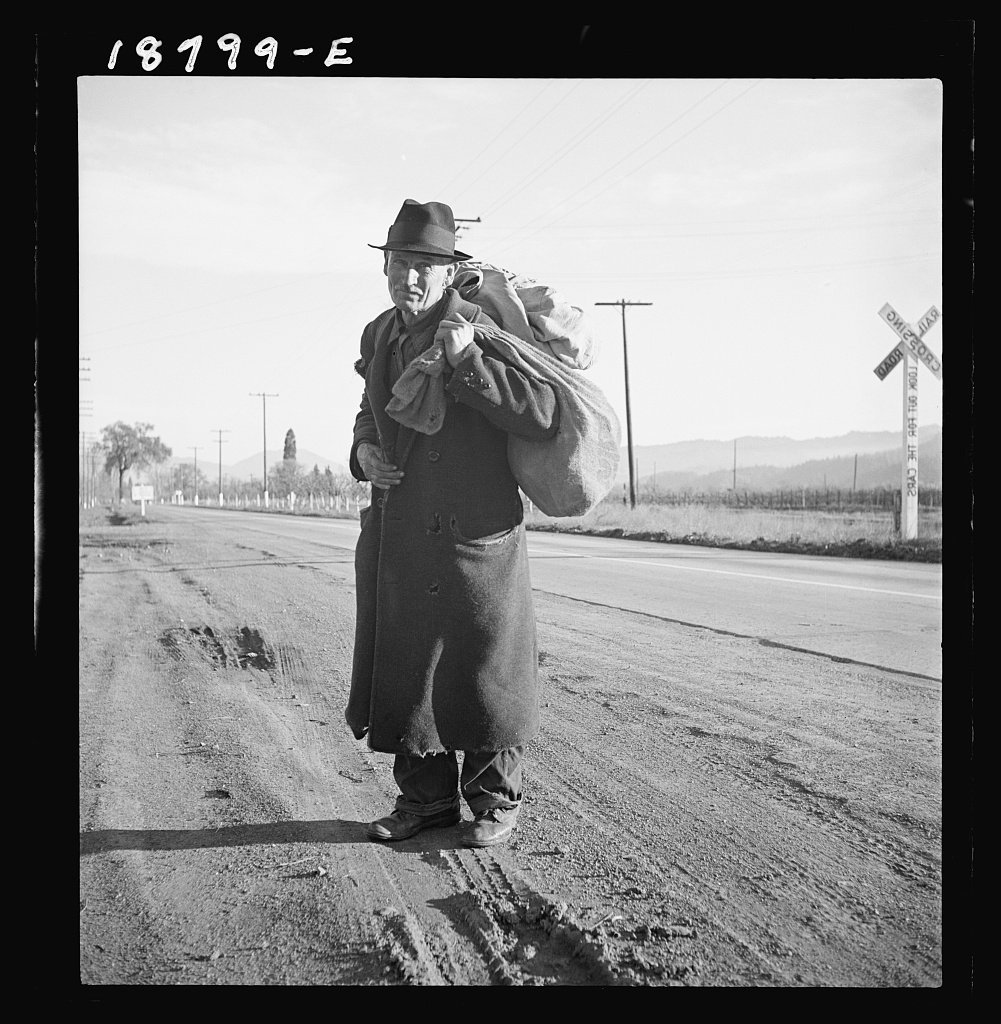
More than twenty-five years a bindle-stiff . Dorothea Lange’s February 1938 portrait in Napa Valley—coat, hat, and sack at a railroad crossing—puts a working traveler’s face beside the written voices below. Library of Congress, FSA/OWI Collection. Source .
Memoirs and early ethnography
A new world was calling to me in every word that was spoken--a world of rods and gunnels, blind baggages and "side-door Pullmans," "bulls" and "shacks," "floppings" and "chewin's," "pinches" and "get-aways," "strong arms" and "bindle-stiffs," "punks" and "profesh." And it all spelled Adventure. Very well; I would tackle this new world. I "lined" myself up alongside those road-kids. I was just as strong as any of them, just as quick, just as nervy, and my brain was just as good.
Jack London · Oakland, California, mid-1890s (published 1907)Jack London, The Road (1907), Project Gutenberg #14658
I rode into Niagara Falls in a "side-door Pullman," or, in common parlance, a box-car. A flat-car, by the way, is known amongst the fraternity as a "gondola," with the second syllable emphasized and pronounced long. But to return. I arrived in the afternoon and headed straight from the freight train to the falls. Once my eyes were filled with that wonder-vision of down-rushing water, I was lost.
Jack London · Niagara Falls, New York, 1894 (published 1907)Jack London, The Road (1907), Project Gutenberg #14658
The judge glanced at the list of cases before him and called out a name. A hobo stood up. The judge glanced at a bailiff. "Vagrancy, your Honor," said the bailiff. "Thirty days," said his Honor. The hobo sat down, and the judge was calling another name and another hobo was rising to his feet. The trial of that hobo had taken just about fifteen seconds. The trial of the next hobo came off with equal celerity. The bailiff said, "Vagrancy, your Honor," and his Honor said, "Thirty days." Thus it went like clockwork, fifteen seconds to a hobo--and thirty days.
Jack London · Niagara Falls police court, 1894 (published 1907)Jack London, The Road (1907), Project Gutenberg #14658
I, too, was a veteran, for had I not been a private in Company L of the Second Division of Kelly's Industrial Army?--said Company L being commonly known as the "Nevada push." But my army experience had had the opposite effect on me; so I left that hobo to go his way to the dogs of war, while I "threw my feet" for dinner.
Jack London · After Kelly’s Army, mid-1890s (published 1907)Jack London, The Road (1907), Project Gutenberg #14658
Even then I did not know what had happened, for I attempted to stand, but found that something had happened to prevent me from doing this. Sitting down in an upright position, I then began to examine myself, and now found that the right foot was severed from the ankle. This discovery did not shock me so much as the thoughts which quickly followed. For, as I could feel no pain, I did not know but what my body was in several parts, and I was not satisfied until I examined every portion of it.
W. H. Davies · Renfrew, Ontario, Canada, c.1899 (published 1908)W. H. Davies, The Autobiography of a Super-Tramp (1908), Project Gutenberg #51425
About half way up the train was situated an empty box car, and to this we were transferred as soon as darkness had fallen. We spread our blankets on the floor and composed ourselves for sleep. But alas and alack! A new crew had come aboard, who had chosen our resting place for a bumper and appeared to be switching all the cars on the middle division with it. We would enter a siding with much grinding and jarring, coming to a stop with a jolt.
Ethel Lynn, M.D. · Midwestern freight division, mid-1910s (published 1917)Ethel Lynn, The Adventures of a Woman Hobo (1917), Project Gutenberg #62971
“Whither away?” he queried. “California or bust,” yelled Dan. The long train jarred to a stop on the siding. A brakeman appeared and entered into conversation. “It must be pretty fierce to ride a wheel through that mud,” he volunteered. “You bet it is,” agreed Dan, “and the track isn’t much better. If I bark any more hide off my shins, I’ll have to buy a pair of crutches.” With a shriek and a roar a passenger train thundered through. The freight pulled slowly off the siding. The engineer leaned out as before, his big, good-natured mouth stretched in a broad grin, his right arm swinging with a scooping motion. “Get aboard! Get aboard!” he shouted. Dan and I exchanged glances. With one accord we jumped for the wheel which stood loaded for the start, and ran it along beside the track.
Ethel Lynn, M.D. (with companion Dan) · Stockdale siding, California, mid-1910s (published 1917)Ethel Lynn, The Adventures of a Woman Hobo (1917), Project Gutenberg #62971
The journey from Syracuse to Buffalo was very prosaic. I rode from Syracuse to Rochester with a kid and two colored tramps. The boy was in search of his "jocker," or protector, whom he had lost in Albany. From various registries at watering-tanks, he expected to find him in Canal Street, Buffalo. At Port Byron a female tramp, with her companion, Milwaukee Jim, entered the box-car in which we were riding.
Josiah Flynt · Syracuse–Rochester–Port Byron, New York, 1890s (published 1899)Josiah Flynt, Tramping with Tramps (1899), Project Gutenberg #40036
Sleepin' out done it, I guess. Anyhow, the crocus[10] says so, 'n' I s'pose he knows. Can't get well, neither. Be'n all over--Hot Springs, Yellarstone, Yosem'ty, 'n' jus' the other day come up from Mex'co. Cough like a horse jus' the same.
Denver Red (quoted by Josiah Flynt) · San Francisco, 1890s (published 1899)Josiah Flynt, Tramping with Tramps (“Jamie the Kid”), Project Gutenberg #40036
I even saw two women on the road, and last summer I saw a woman beating her way in a box car.
Unnamed tramp (recorded by Nels Anderson) · Chicago fieldwork, early 1920s (published 1923)Nels Anderson, The Hobo (1923), Project Gutenberg #67300
I came in last night with $380 and now I’m flatter’n a pancake. I didn’t even get a pair of sox. Hallelujah! I’m a bum.
Unnamed worker (recorded by Nels Anderson) · West Madison Street, Chicago, early 1920s (published 1923)main stem —irony before the hangover.Nels Anderson, The Hobo (1923), Project Gutenberg #67300
I get a lot of ‘kick’ out of riding trains out of a place when I know the ‘dicks’ are trying to keep me off.
Unnamed lad (recorded by Nels Anderson) · Chicago fieldwork, early 1920s (published 1923)Nels Anderson, The Hobo (1923), Project Gutenberg #67300
All whom I interviewed spoke of it as the hardest railroad in the United States for a tramp to beat, and I could not have learned more of the tramps' opinion of it had I remained exclusively on the property.
Josiah Flynt · Riding neighboring lines as an undercover investigator, 1890s (published 1899)Josiah Flynt, Tramping with Tramps (1899), Project Gutenberg #40036
WPA life histories (1936–40)
Federal Writers’ Project fieldworkers collected life histories and folklore across the Depression. The Library of Congress holds the typescripts as public-domain U.S. government work. The voices below are Depression-era interviews—and, in Harry Kemp’s case, a tramp-poet’s own ballade of earlier freight nights—quoted from the item pages linked in each citation.
I hitched another freight, picked up a couple of fellers, and started west again. You know ridin’ them rods when your goin’ down a hill you could almost read a newspaper by the light the wheels make as they turn over. Funny, ain’t it?
Joe Stangler · Portland, Oregon, 8 Jan. 1939 (filed 10 Jan. 1939)riding the rods toward Jim Hill’s Cascade tunnel.“Western Work Gangs,” Library of Congress, American Life Histories (WPA)
Now on de bum, sure, I don’t care. Eat, go anyplace I want, do what I like. You tink I care about rich man? Rich man can’t sleep. I sleep good—nobody gotta worry about me. … Man can travel—on odder side, tink you can do dis? I answer you every question—no. Sure I know, I come from one dem countries. No, not Germany—Holland.
Unnamed tramp (Dutch-born beachcomber) · Near Fulton Fish Market, New York City, 22 Nov. 1938 (filed 25 Nov. 1938)“Under the Bridge,” Library of Congress, American Life Histories (WPA)
There’s one thing dear to both tramps and poets—and that’s freedom.
Harry Kemp · 64 Washington Square South, New York City, Dec. 1938 (filed 11 Jan. 1939)“Tramp Poet,” Library of Congress, American Life Histories (WPA)
The cars lay on a siding through the night;
Harry Kemp · from “Recollection (…A Ballade of Former Tramp-Days),” copied in the Dec. 1938 interview“Tramp Poet,” Library of Congress, American Life Histories (WPA)
Chuck Hanson advised me not to worry about lice. “You’ll soon get used to ’em, not feel ’em biting at all. All you have to do is ‘boil up’ once in a while”—that is, take off your clothes and boil them, a piece at a time, to kill the vermin. These and other personal chores the well-groomed tramp more or less regularly performs, were usually attended to during stop-overs in camps and jungles. … Summer time is no cinch for the bindlestiff, but when the cold days of autumn come along, then his troubles really begin. … [O]n chilly nights, they would sleep in empty box cars in freight yards, … the more in one car the better, for the animal heat of our bodies served to
Harry Kemp · recalling road years, Dec. 1938 interview (typescript breaks mid-sentence)bindlestiff cold, and packed box cars for warmth.“Tramp Poet,” Library of Congress, American Life Histories (WPA)
A richman takes a taxi cab
Unnamed children (street rhyme) · New York City, filed 12 Dec. 1938“Dead End Kids,” Library of Congress, American Life Histories (WPA)
That closes the People of the Rails wing. The next corridor turns from who rode—and how they spoke—to how they talked in code, signed walls, sang, and policed themselves: Culture and Code.
See Sources for works and archives cited in this room.
Previous room The boxcar kidsNext room Culture and Code